How to Spec a Packing Cube Set for Retail

A packing cube set is not one product. It is a composed line of travel organizers that a brand sells as a single retail unit. Buyers who treat it as a single SKU miss the decisions that determine landed cost, durability, and shelf appeal. You are really specifying three to seven small products, one carton, and one price point. Get the composition wrong and the set returns to your warehouse. Get it right and it becomes a repeat seller.
We build packing cube sets for brands and retailers. Camytonc has been operating since 2013. This guide walks through the decisions a sourcing manager makes before requesting a quote: piece mix, size tiers, fabric, mesh panels, zippers, compression, and retail packaging. No invented test data. No fake certifications. Just the questions we ask every buyer who contacts us about a private-label set.
How a packing cube set is composed
Most retail sets fall between three and seven pieces. A three-piece set is usually small, medium, and large cubes. A five-piece set adds a slim cube and a shoe bag or laundry pouch. Seven-piece sets often include two extra small cubes, a toiletry pouch, and a drawstring bag for shoes or dirty laundry.
Piece count is a retail positioning decision. A three-piece set at a low price point works for first-time travelers. A seven-piece set signals a complete travel system and supports a higher price. But more pieces means more cutting, more sewing, more hardware, and more packaging. The landed cost per set rises faster than the perceived value if the extra pieces are too similar.
Size tiers are the backbone of the set. A typical tier runs from a small cube for socks and underwear to a large cube for jackets or jeans. The exact dimensions come from the luggage the set is designed to fit. A set built for carry-on luggage uses shallower cubes. A set built for checked luggage can go deeper. The shoe bag and laundry pouch are separate pieces with different functions, not just different sizes.
One mistake we see from first-time buyers is ordering one cube in five sizes and calling it a set. That misses the point. A strong retail set includes pieces that solve different packing problems: compression for bulky clothes, a mesh-top cube for quick identification, a solid-top cube for shoes, and a laundry pouch for dirty items. The mix, not just the count, is what makes the set feel complete.
Matching cube dimensions to carry-on and checked luggage
Cube dimensions only make sense in relation to luggage interiors. A cube that is too tall for a carry-on suitcase forces the traveler to leave it out. A cube that is too narrow for a checked bag wastes space. The buyer's job is to design a size tier that packs efficiently into the target luggage category.
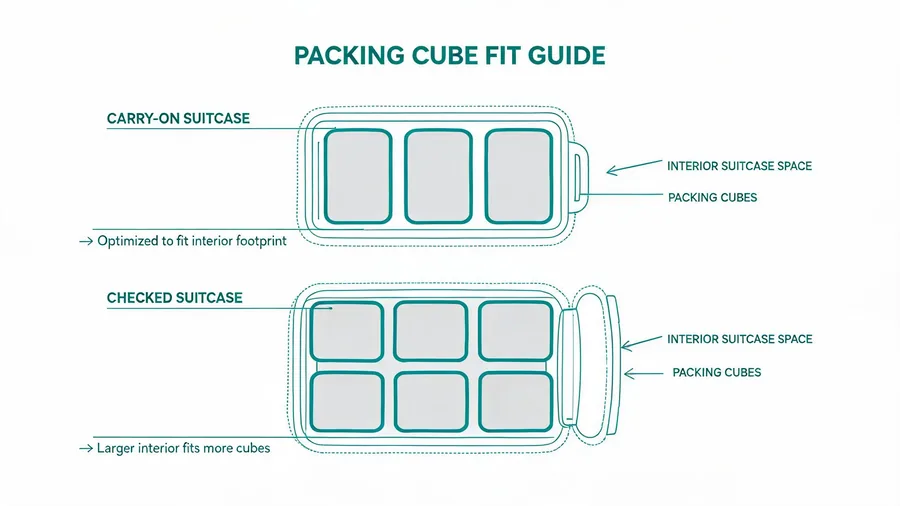
Carry-on luggage interiors are shallower than checked luggage interiors. A cube designed for carry-on use should sit below the top edge of the bag when the lid closes. If the cube is too deep, the traveler cannot use the full width of the suitcase because the cube blocks the lid. Checked luggage allows deeper cubes, but the same logic applies: the cube should not force the traveler to pack around it.
Width and height matter more than many buyers expect. A cube that is wider than the luggage interior forces a diagonal placement and wastes corner space. A cube that is too narrow leaves gaps. The ideal set fills the luggage base with two or three cubes side by side, leaving a small margin for the zipper track and the suitcase's curved corners.
Dimension tolerance matters in production. A cube spec that says 40 cm wide will not arrive at exactly 40 cm every time. Fabric stretch, sewing seam allowance, and zipper tape all pull the finished dimension. A tolerance of plus or minus a stated amount, agreed in the spec, prevents a cube from becoming too large to fit the target luggage. Buyers who skip this step end up with cubes that measure fine on the sample table and fail in the suitcase.
Here is a sample size tier table. Use it as a starting point, not a spec. Your actual dimensions depend on your target luggage and your tolerance agreement.
| Piece | Typical purpose | Carry-on planning | Checked-luggage planning |
|---|---|---|---|
| Small cube | Socks, underwear, accessories | Shallow depth, fits lid pocket | Same depth or slightly deeper |
| Medium cube | T-shirts, light layers | Half the luggage width | Half width, deeper |
| Large cube | Jeans, sweaters, jackets | Full width, shallow | Full width, deep |
| Slim cube | Belts, chargers, flat items | Fits along the side rail | Fits in the lid or base |
| Shoe bag | Footwear, dirty items | Fits one pair, low profile | Fits two pairs, taller |
| Laundry pouch | Dirty clothes separation | Flat, packs at the end | Flat or lightly filled |
For more on sizing logic, read our packing cube size guide.
Fabric options for packing cubes
Fabric choice sets the cost floor and the durability ceiling. The most common shell fabrics are ripstop nylon and polyester. Ripstop nylon is light and resists tear propagation because of the reinforcement grid. Polyester is dimensionally stable, widely printable, and often cheaper at the same visual weight. Both come in a range of deniers and grams per square meter.
Weight matters. A heavier fabric resists abrasion better but adds weight to every cube in the set. A lighter fabric keeps the set travel-friendly but may show wear faster at the corners and zipper seams. The right weight depends on the retail position. A premium travel brand might spec a heavier ripstop nylon. A value-oriented set might use a lighter polyester with a coating for structure.
rPET and recycled-content options are available. Many buyers now ask for recycled polyester or nylon in their packing cube sets. The fabric performs similarly to virgin material when the specification is controlled. The difference is in the supply chain documentation and the price. If your retail customer requires recycled content, ask the supplier for the material certification and the percentage of recycled fiber in the finished fabric.
Mesh panels are the second fabric decision. Mesh is an open structure used for ventilation and visibility. A mesh top lets the traveler see the contents without opening the cube. The trade-off is less protection from dust and moisture. A solid top protects contents better but hides them. Many sets use a hybrid: solid sides and a mesh top panel. That gives structure, visibility, and a lower weight than a fully solid cube.
Coatings and water resistance are optional. A polyurethane coating improves water resistance and hand feel. A polyvinyl chloride coating adds stiffness and stronger moisture resistance. These coatings add cost and change the drape of the fabric. For most packing cube sets, a light coating on the base panel is enough to protect against damp surfaces. Full waterproofing is rarely necessary and adds weight and price.
Our packing cube fabrics guide covers weights and coatings in more detail.
Mesh versus solid tops and visibility
The top panel is the most visible part of the cube and the most debated spec point. Mesh tops help content identification. A traveler can see which cube holds socks and which holds chargers without opening a single zipper. That speeds up packing and unpacking. It also reduces the chance of opening the wrong cube and spilling the contents.
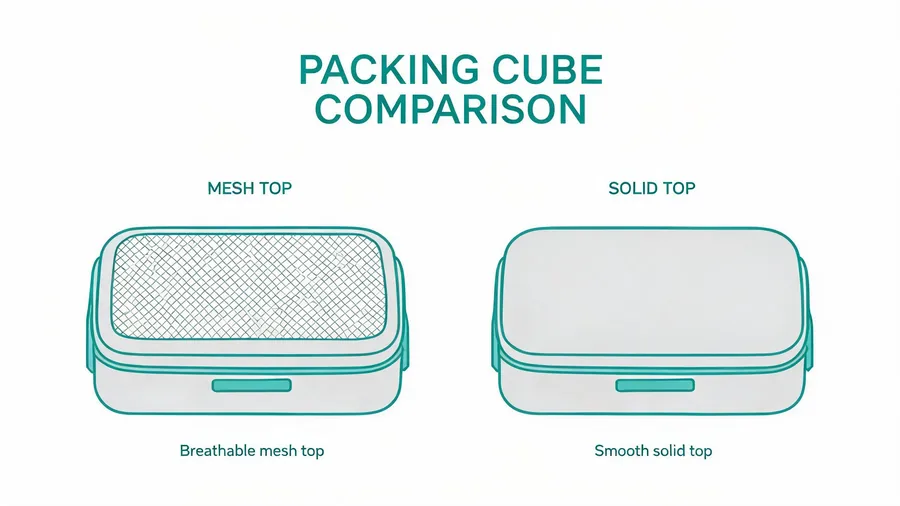
Solid tops protect contents. They keep dust out, contain small spills, and hide the contents from view. A solid top is the right choice for a shoe bag or a laundry pouch. It is also the right choice for cubes that hold delicate items or anything the traveler does not want visible.
Hybrid panels are common. A cube can have a solid front panel and a mesh top panel. Or a mesh window set into a solid top. The hybrid approach balances visibility and protection. It also changes the cost. Mesh is usually cheaper than a coated solid fabric at the same panel size, but it requires a binding or frame to hold its shape. The sewing time can offset the material savings.
The top panel choice affects weight. Mesh is lighter than a coated solid panel. In a seven-piece set, the difference is small per cube but noticeable when the whole set is weighed for shipping. If your retail customer markets the set as ultralight, every panel decision matters.
Zippers, sliders, handles, and compression variants
Zipper size is a durability decision. A larger zipper with bigger teeth survives more cycles but adds weight and cost. A smaller zipper is lighter and cheaper but fails sooner under load. The zipper on a compression cube carries more stress than the zipper on a standard cube because it pulls the panels together against the load. Buyers should ask the supplier which zipper size they recommend for the compression pieces.
Double sliders are worth the small extra cost. A double slider lets the traveler open the cube from either end and close it from the middle. That is a real usability improvement, especially on a large cube that holds bulky clothes. It also distributes the zipper pull load across two sliders instead of one.
Handle placement is often an afterthought. A packing cube set needs a grab handle on at least the medium and large cubes. The handle should be sewn into a reinforced seam, not just topstitched onto the panel. A handle that rips off on the first trip turns a good review into a bad one. The handle should sit on the side or top edge, not on the mesh panel, unless the mesh is reinforced.
Compression variants add a second zipper system. A compression cube has the main zipper for access and a compression zipper that runs around the body or across the side. When the compression zipper closes, it pulls the top and bottom panels together and squeezes the load. This is mechanical compression, not vacuum sealing. No air pump, no airtight seal. The compression comes from a folded fabric gusset that is taken up by the second zipper.
Compression cubes fail at the stress points. The compression zipper pulls against the gusset fabric, the zipper tape, and the corner seams. If the gusset fabric is too light or the seam allowance is too small, the cube tears at the corner after a few compression cycles. Ask the supplier to show you the reinforcement at the compression zipper ends. A bartack at each end is the minimum.
Read our compression packing cube guide for the full mechanics.
Packaging a set for retail
Retail packaging is part of the product. A packing cube set that arrives in a plain poly bag looks like a commodity. A set in a color box with a hang tag looks like a brand. The packaging choice also affects shipping cost, carton quantity, and the condition of the cubes when the customer opens the box.
The packaging options from our factory are: poly bag, color box, gift box with handle bag, branded poly mailer, hang tag with poly bag, and dust bag. Each one suits a different retail channel. A poly bag is cheapest and works for e-commerce where the customer never sees the shelf. A color box works for physical retail where the set sits on a shelf next to competitors. A hang tag adds branding without the cost of a full box.
Shape-control inserts matter for sets. A packing cube set in a color box needs an insert or folded card to hold the cubes in position during shipping. Without it, the cubes shift and the box looks crushed on the shelf. The insert also prevents the mesh panels from creasing permanently. Ask the supplier what insert they recommend for your box dimensions.
Carton quantity and marks are part of the spec. The outer carton quantity depends on the set size and the packaging method. A three-piece set in poly bags packs more units per carton than a seven-piece set in gift boxes. The carton marks need the product code, quantity, and any retail barcode or country-of-origin labeling. Shipping tests, such as a drop test or vibration test, should be agreed in the spec and the acceptance limits written down before production starts.
Spec fields to prepare for a quote
When you request a quote, the supplier needs a complete spec. Incomplete specs produce quotes that are not comparable. One supplier quotes a lighter fabric. Another quotes a smaller zipper. You cannot tell which is the better value because you did not give them the same target.
Here is the minimum spec checklist we ask every buyer to prepare. Copy it and fill it in before you contact any supplier.
- Product name and intended use: private-label packing cube set, target traveler, target luggage category.
- Set composition: number of pieces, size tier for each piece, whether a shoe bag or laundry pouch is included.
- Dimensions for each piece: height, width, depth, and tolerance for each cube.
- Capacity target: internal volume in liters or a stated fill test method.
- Material composition for each panel: shell fabric, mesh type, lining, coating, and recycled-content percentage if required.
- Bill of materials: zipper size, slider type, pull material, handle webbing, binding tape, and any reinforcement patches.
- Artwork: logo dimensions, placement coordinates, print or embroidery process, and color references.
- Label requirements: brand label content, care label, country of origin, and traceability code.
- Packaging: packaging method, shape-control insert, hang tag, carton quantity, and carton marks.
- Performance tests: test methods, sample size, acceptance limits, and report format.
The more complete this list is, the faster you get an accurate quote. A buyer who sends only a photo and a target price gets a guess. A buyer who sends a spec gets a number they can hold a supplier to.
We work with a BSCI-certified factory with 30,000+ square meters of factory area, 500+ workers, 100+ designers, and 50+ automated production lines. Our factory holds amfori BSCI, ISO 9001, SGS, TUV, and GRS certifications. If you are building a packing cube set for retail, contact us with your spec and we will quote it.
For more on how compression changes the set, see our compression packing cubes page. For durability questions, read what makes a packing cube durable.
Frequently Asked Questions
Are packing cubes worth buying for a retail product line?
Yes, if you position them as a system rather than a commodity. Packing cubes solve a real travel problem: keeping a suitcase organized. A retail set with a clear size tier, a compression piece, and a laundry pouch can command a higher price than a single cube. The risk is entering the market with a generic three-piece set that looks identical to everything else on the shelf. The margin is in the composition and the fabric spec, not in the lowest price.
What makes a good packing cube set for carry-on luggage?
Shallow cubes that sit below the lid line, a size tier that fills the luggage base with two or three cubes side by side, and a compression piece for bulky clothes. The fabric should be light enough to keep the set from eating into the airline weight allowance. A mesh top helps the traveler find things quickly at security. The zipper and handle need to survive being pulled in and out of an overhead bin.
What should not be packed in compression cubes?
Anything that cannot recover from being squeezed. Compression cubes work by pulling the panels together against the load. That pressure can crease structured garments, crush hats, or damage delicate fabrics. Do not pack shoes with hard soles, electronics, or anything with a rigid frame. Liquids should go in a separate pouch. The compression cube is for soft, bulky clothing like t-shirts, sweaters, and jeans.
How many pieces should a retail packing cube set include?
Between three and seven. Three pieces is the entry point and keeps the price low. Five pieces is the sweet spot for most brands: small, medium, large, a slim cube, and a shoe bag or laundry pouch. Seven pieces signals a complete travel system but adds cost to every set. The right number depends on your retail price point and whether the extra pieces solve a different packing problem or just repeat the same size.