What Makes Packing Cubes Durable: A Buyer's Guide
Durable packing cubes fail in predictable places. The zipper, the mesh, the corners, the seams. A buyer who knows those failure points can write a spec that eliminates most of them before the first sample is sewn. This guide walks through the construction details that separate a cube that lasts five trips from one that lasts five years.
Most packing cube failures are not material failures. They are specification failures. Somebody chose a fabric weight that was too light for the load. Somebody approved a zipper that was too narrow for the panel it closes. Somebody skipped the binding on an internal seam. Fix the spec and you fix the product.
We make custom packing cubes for brands and retailers. The questions below are the ones we ask every buyer before we quote a new design. If you are comparing factories or reviewing a supplier's sample, this is the checklist to use.
Fabric Weight and Weave
The shell fabric is the first thing a buyer touches. It is also the first thing that fails on a cheap cube. A packing cube gets stuffed, compressed, dragged across luggage interiors, and zipped under tension. The fabric needs to handle all of that without tearing or fraying.
Denier is the yarn linear-density unit used to describe synthetic bag fabrics. It does not directly state finished-fabric strength. A 210D nylon with a tight weave and a good coating can outperform a poorly woven 420D polyester. The weave matters as much as the yarn size.
Ripstop is the construction that matters most here. Ripstop fabric has reinforcement yarns arranged in a grid. When a tear starts, it hits one of those yarns and stops instead of running down the panel. For a packing cube that gets overstuffed, ripstop is the difference between a small puncture and a ruined panel.
For standard packing cubes, buyers usually specify nylon or polyester in the range that balances weight against puncture resistance. The exact GSM or denier depends on the cube's intended load. A cube for bulky sweaters needs a different shell than a cube for dress socks. We ask the buyer what goes inside before we recommend a fabric.
Coating is the second decision. A polyurethane coating improves water resistance and gives the fabric a firmer hand feel. A polyvinyl chloride coating adds stiffness and strong moisture resistance. Neither is automatically better. The choice depends on whether the buyer wants a soft, packable cube or a structured one that holds its shape.
Mesh Panel Quality
Mesh is the most common failure point on mid-priced packing cubes. The mesh panel lets you see what is inside and helps the cube breathe. It also blows out under load.
The failure mode is predictable. A user overstuffs the cube. The mesh stretches. The yarns separate at the seam line or in the center of the panel. The hole gets bigger every time the cube is packed. Within a few trips, the panel is useless.
Cheap mesh is knitted loosely and has no reinforcement at the edges. Good mesh is denser, with a stable knit that resists deformation. The edge treatment matters too. A mesh panel that is simply sewn to the shell will pull away under tension. A mesh panel with a bound edge or a folded hem distributes the load across the seam instead of concentrating it on the first row of stitches.
We test mesh panels by loading the cube beyond its rated volume and pulling on the mesh from the inside. A good panel stretches slightly and returns to shape. A bad panel deforms permanently. The test is simple and it predicts real-world failure better than any spec sheet.
The Zipper Is the Primary Failure Point
Ask any luggage repair shop what they fix most often. It is zippers. The zipper on a packing cube takes more abuse than almost any other component. It is opened and closed under load, pulled at awkward angles, and forced around overstuffed corners.
There are two things to specify: the chain type and the slider quality.
Coil zippers are the standard for packing cubes. They are flexible, lightweight, and easy to sew. But coil zippers come in different sizes. A narrow coil with a small tooth profile will separate under lateral load. A wider coil with a larger tooth profile holds better when the cube is packed tight.
Molded tooth zippers are stronger but stiffer. They are rarely the right choice for a soft-sided packing cube. The stiffness makes the cube harder to pack and the zipper is more likely to catch on the fabric.
The slider matters as much as the chain. A cheap slider with a loose body will skip teeth or jam. A slider with a strong pull tab and a smooth interior finish will cycle thousands of times without failing. Zipper cycling tests exist specifically to evaluate operating force and durability under repeated use. We run them on every new zipper we approve.
The zipper tape is the third component. The tape is the fabric strip the coil is attached to. If the tape is too narrow or too weak, the zipper will tear away from the shell even if the coil and slider are fine. Specify a tape width that matches the panel edge and use a seam construction that supports the full tape width.
Seam Construction and Binding
The seams are where a packing cube holds together under stress. They are also where cheap construction shows first.
A basic seam is two pieces of fabric stitched together with a single row of stitching. That is fine for a low-stress area. It is not fine for the main compartment seams on a packing cube. Those seams carry the full load of the packed cube every time it is lifted, compressed, or thrown into a suitcase.
Bound-seam construction covers the internal seam allowances with binding. The binding protects the raw edges and adds a second line of stitching. This is the minimum standard for a durable packing cube. The binding prevents fraying and distributes the load across two stitch lines instead of one.
Turned construction is another option. The assembly is inverted after stitching so the seam allowances remain inside. This gives a clean finish but it does not add the same reinforcement as binding. For high-stress seams, use both: a turned seam with the internal allowance bound.
Stitches per inch is a stitch-density measure that affects seam appearance, flexibility, and performance. Too few stitches per inch and the seam is weak. Too many and the fabric perforates and tears along the stitch line. The right range depends on the fabric and the location. A seam under the zipper needs more stitches per inch than a seam on a flat panel.
Corner Reinforcement and Compression Loading
Corners concentrate stress. When a packing cube is compressed, the fabric pulls toward the center. The corners take the most tension. If the corner is just two panels meeting at a single stitch line, it will fail.
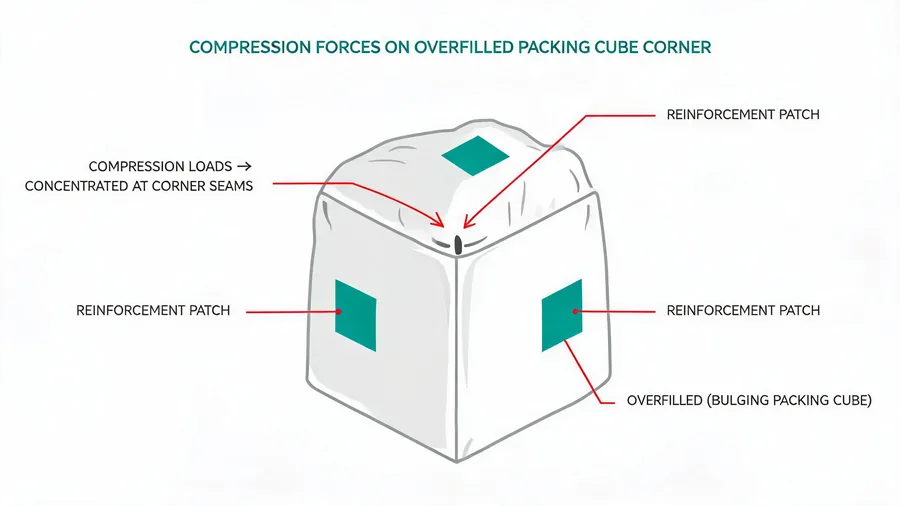
A reinforced corner has an extra layer of fabric or webbing at the stress point. A bar tack is a dense short stitch pattern used to reinforce high-stress points. A box-X stitch is a rectangular reinforcement stitch with diagonal crossing lines, commonly used at webbing attachments. Both are appropriate for packing cube corners.
Compression loading changes the stress pattern. A compression packing cube has a second zipper that pulls the top and bottom panels together. That zipper adds tension to the side panels and the corners. The corner reinforcement has to handle the extra load or the cube will tear at the compression point.
We see this failure on cheap compression cubes all the time. The manufacturer adds a compression zipper but does not upgrade the corner construction. The cube works for a few trips, then the corner blows out. The fix is not a stronger zipper. It is a stronger corner.
Tests That Reveal Weaknesses
You cannot tell if a packing cube is durable by looking at it. You have to test it. The tests below are standard in the bag industry and they expose the weaknesses described above.
Tensile strength measures resistance to pulling force before rupture. Tear strength measures resistance to the growth of a cut or initiated tear. Seam strength measures the force required to break the seam, material, or stitch system near a joint. These three tests tell you whether the fabric, the weave, and the stitching can handle the load.
Abrasion resistance measures surface wear under repeated rubbing or contact. Packing cubes rub against each other inside a suitcase. A fabric that fails abrasion testing will look worn after a few trips, even if it never tears.
Zipper cycling opens and closes the zipper repeatedly to evaluate operating force and durability. This is the test that catches cheap sliders and weak tape. It is also the test most factories skip because it takes time.
Drop testing is a product-level test. A packed cube is dropped from a defined height and orientation to evaluate structural and content protection. It simulates the cube being thrown into a suitcase or dropped on a hotel floor. The exact drop height and orientation are set in the approved specification.
Dimensional inspection is the final check. Finished dimensions are compared with the approved measurement method and tolerance table. A cube that is sewn too small will be overstuffed every time. A cube that is sewn too large will not hold its shape. Both problems shorten the life of the product.
What a Buyer Should Specify and Inspect
Here is the translation from failure point to specification. This is the table we use when we review a new packing cube design with a buyer.
| Failure point | What to specify | What to inspect on the sample |
|---|---|---|
| Shell fabric tears | Ripstop nylon or polyester, minimum GSM set by load | Check for reinforcement yarns in the weave, test tear strength |
| Mesh panel blows out | Dense knit mesh, bound or folded edge | Pull the mesh from inside, look for permanent deformation |
| Zipper separates | Wide coil chain, strong slider, adequate tape width | Cycle the zipper under load, check for skipped teeth |
| Seam frays or splits | Bound-seam construction, adequate stitches per inch | Pull the seam apart, check for two stitch lines and covered edges |
| Corner blows out | Bar tack or box-X stitch at each corner | Inspect the corner, pull it hard, look for reinforcement |
| Compression zipper tears panel | Reinforced side panels and corners | Compress the cube fully, check for stress marks at the corners |
The inspection step is where most buyers save themselves from a bad production run. A sample can look perfect on the table and fail the first time it is packed. Pull the mesh. Cycle the zipper. Overstuff the cube. If it survives that, it will probably survive a suitcase.
For buyers comparing packing cubes for backpacks, the stress profile is different. Backpack cubes get compressed more aggressively and packed into irregular spaces. The corner reinforcement and zipper quality matter even more.
One more thing. The cheapest quote is rarely the cheapest product. A factory that quotes a low price is cutting something. Usually it is the binding, the corner reinforcement, or the zipper. You will not see the cut on the sample photo. You will see it in the returns.
If you are not sure what to specify, start with the table above. Send it to your supplier. Ask them to confirm each point in writing. A factory that can answer those questions is a factory that knows how to make a durable packing cube. A factory that cannot is guessing.
We answer those questions every day. It is the first step in our custom packing cube process.
Frequently Asked Questions
What fabric is best for durable packing cubes?
Ripstop nylon or polyester is the best starting point. The ripstop weave stops tears from spreading. The exact weight depends on what you pack. A cube for heavy items needs a heavier fabric than a cube for socks.
Why do packing cube zippers break?
They break because the chain is too narrow, the slider is cheap, or the tape is too weak. Under load, the zipper separates or the tape tears away from the shell. Specify a wide coil chain, a strong slider, and a tape width that matches the panel edge.
How can I tell if a packing cube is well made?
Look at the corners and the seams. The corners should have bar tacks or box-X stitches. The internal seams should be bound, not raw. Then pull the mesh panel hard and cycle the zipper under load. A good cube survives that.
Are compression packing cubes less durable than regular ones?
They can be, because the compression zipper adds stress to the side panels and corners. A well-made compression cube has reinforced corners and panels to handle that extra load. A cheap one will blow out at the compression point.