- Home
- Packing Cubes Wholesale
Packing cubes wholesale, with or without your logo
Two routes: ready-to-ship sets in 24 to 48 hours, or full private label from your spec.
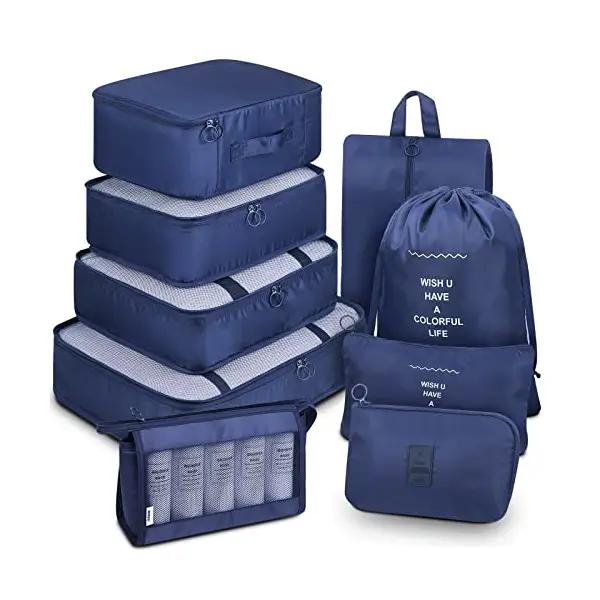
Wholesale terms at a glance
| MOQ | Low MOQs - contact us; depends on fabric, construction and set composition |
|---|---|
| Reference set lead time | 9-piece A-4618: 1-200 pcs 25 days; 201-500 pcs 30 days; over 500 negotiated |
| Ready to ship | 24-48 hour dispatch, mixed styles and colors; logo on stock items 3-7 days |
| Packaging | Poly bag, color box, gift box with handle bag, branded poly mailer, hang tag with poly bag, or dust bag |
| Factory | BSCI-certified factory in Yiwu, Zhejiang, China; 30,000+ m² floor, 500+ workers, 100+ designers, 50+ automated lines |
| Capacity | 150,000 units monthly output; 220+ fabric suppliers |
| Certifications | amfori BSCI, ISO 9001, SGS, TUV, GRS |
| Samples | Paid samples in 1-10 days; one revision round in 2-3 days |
| Quality control | Final inspection step (2-3 days) against the approved sample before packing |
| Rush options | +20% fee cuts lead time about 30%; +30% about 50%; +40% about 70% |
| Pricing | Quoted per specification and quantity; send your target quantity and spec for a price |
| Shipping | Sea, rail or air; courier door to door in 5-7 working days for small lots; sea freight 40-45 days |
| Payment | T/T, L/C, D/P and D/A, credit card, PayPal, MoneyGram, Western Union |
| Reply time | Within 24 hours |
Built for: Marketplace sellers, travel retailers, DTC brands and corporate gift buyers.
How do I get wholesale pricing for packing cubes?
Send target styles, quantities and whether you need your logo. Pricing is quoted per specification, and we reply within 24 hours.
Go deeper: Private label terms, Set compositions, Fabric options.
Ready-to-ship program
Bestselling sets like our 9-piece travel organizer dispatch in 24 to 48 hours, with mixed styles and colors in one order. Add your logo to stock items in 3 to 7 days. Use it to test listings before committing to a custom run.
Private label program
Your dimensions, fabrics, colors and retail packaging, patterned and produced to order. See private label packing cubes for the full terms, set compositions and fabric options. Full custom production runs 7 to 15 days after sample approval for standard constructions. MOQs for packing cubes depend on fabric and set composition. Low MOQs - contact us.
What wholesale buyers ask us to change
Packing cubes leave more room for differentiation than most soft goods. These are the levers.
Fabric
Ripstop nylon for weight, polyester for cost, rPET for sustainability positioning. Mesh panel size is a design choice, not a fixed spec.
Color and branding
Pantone-matched dyeing within a Delta E of 2.0. Woven labels, metal plates, heat-press PVC, laser and reflective logo processes.
Packaging
Six options from plain poly bag to gift box with handle bag, plus branded poly mailers and hang tags for marketplace-ready units.
Terms that matter at PO time
- Payment: T/T, L/C, D/P and D/A, credit card, PayPal, MoneyGram, Western Union and third-party platforms.
- Logistics: sea, rail and air freight; door-to-door express by DHL, FedEx, UPS or TNT in 5 to 7 working days; sea freight 40 to 45 days.
- After-sales: 24-hour response with replacements, credits or technical support.
- Rush production: surcharge tiers cut lead time by 30%, 50% or 70%.
Request wholesale pricing
Send quantities and target styles. We reply within 24 hours with a route recommendation.
Get a QuoteMaterials and Construction Options for Packing Cubes
Packing cubes wholesale buyers tend to focus on size and color first. That's understandable. The size sells the product. The material decides whether the customer buys again. A cube that feels flimsy, snags zippers, or tears at a corner seam generates returns and bad reviews. A cube built from the right fabric and foam can survive years of airport abuse. So the material conversation is really a returns conversation.
The shell fabric does most of the visible work. It holds the shape, takes the abrasion from luggage interiors, and carries the print or color. The mesh, if present, handles ventilation and visibility. The foam or stiffener controls whether the cube stands up or collapses into a sad pile. The zipper is the highest-failure component in the category. Buyers who specify a cheap zipper on an otherwise good cube will hear about it from customers.
Our factory uses the standard material families from the bag industry reference. Each behaves differently under load, moisture, and repeated packing. The table below is a practical comparison for this category. It is not a lab report. It is what we tell buyers when they ask why one cube costs more than another.
| Material | What it is good for | Where it fails |
|---|---|---|
| Nylon fabric | High strength to weight, good abrasion resistance, soft hand feel, takes dye well for custom colors | Higher cost; lower UV resistance than polyester; can stretch under heavy load if the weave is loose |
| Polyester fabric | Dimensional stability, wide range of weights and weaves, good printability, lower cost, dries fast | Can feel stiffer or noisier; lower abrasion resistance than nylon at the same denier in some constructions |
| Canvas or cotton duck | Natural texture, structure, premium shelf appeal, patina with use | Heavier, absorbs moisture, slower to dry, requires more care in colorfastness and shrinkage control |
| Ripstop fabric | Grid reinforcement limits tear propagation, good for lightweight but tough cubes | Grid texture may show through printing; cost premium over plain weave |
| Mesh | Ventilation, visibility, stretch pockets, lightweight organization | Lower structure, can snag on sharp objects, less protective against dust or spills |
| Transparent film (TPU or PVC) | Wipe-clean, visibility for TSA or organization, modern look | Can yellow or stiffen over time, higher cost, welding required for clean edges |
Foam matters more than most buyers expect. Open-cell foam breathes but absorbs moisture and loses structure when wet. Closed-cell foam, including expanded polyethylene, resists water and holds shape better. For packing cubes, a thin closed-cell foam panel in the base or side gusset is the difference between a cube that stands open on a hotel bed and one that flops over. The reference guide lists foam thickness as a measured specification. We fix that value in the approved spec sheet, not in marketing text.
Lamination and coating are worth a mention. A polyurethane coating on the inner face makes the cube easier to wipe clean and adds a little water resistance. Thermoplastic polyurethane film can make a cube nearly waterproof, but it changes the hand feel and the cost. Most packing cubes do not need a waterproof laminate. They need a fabric that does not tear at the seam and a zipper that does not fail.
If you are comparing suppliers, ask about the product specifications behind the sample. A supplier who cannot tell you the fabric weight, weave, and coating is selling a generic cube. A supplier who can tell you the foam type and the zipper brand is a partner. The difference shows up in your return rate.
How Different Buyers Should Specify This Product
Three buyers can ask for a packing cube and mean three different products. The specification decisions that actually change the outcome depend on who the buyer is and where the cube will be sold. Here are three common situations we work through with packing cubes wholesale customers.
Situation one: a travel brand selling direct to consumers. This buyer cares about weight, packability, and durability. Their customer reads reviews before buying. A cube that adds 200 grams to a carry-on is a problem. So the shell fabric should be lightweight but tear resistant. The allowed fabric spec ranges in our reference cover nylon and polyester weights and weaves. We work within those ranges, and the exact value gets fixed in the approved specification. Ripstop is a strong candidate here because the grid reinforcement limits tear propagation without adding much weight. The zipper should be a self-healing coil zipper with a decent slider. The foam, if any, should be minimal. A thin closed-cell panel in the base is enough. This buyer should also specify a compression zipper if they want the cube to shrink after packing. That decision changes the pattern, the gusset, and the sewing sequence. See our compression packing cubes page for how that mechanism works.
Situation two: a retailer buying for shelf appeal. This buyer needs the cube to look good in a display and feel substantial when a shopper picks it up. Weight is less of a concern. Structure is more important. A canvas or cotton duck shell gives a premium texture and holds its shape on a shelf. Polyester is the budget option, but the weave and coating matter more than the fiber alone. The reference guide lists polyester in several weights and weaves. We pick from those ranges based on the target retail price. The retailer should also think about packaging. A cube sold in a polybag looks cheap. A cube sold with a hang tag and a branded poly mailer looks intentional. The packaging options are listed in our trade terms.
Situation three: a corporate gifting or promotional buyer. This buyer needs a cube that looks branded, costs little, and survives being thrown into a conference swag bag. The spec decisions are simpler. A polyester shell from the allowed range works. The buyer should not over-specify. A lightweight weave is fine for this use case. The logo placement changes the tooling discussion, which we cover below. The key risk for this buyer is overpaying for features the recipient will never notice. A compression zipper, waterproof lamination, and premium foam are wasted on a giveaway cube. Specify a clean, simple cube with a good logo area and a reliable zipper. That is the whole brief.
Each of these buyers needs a different dimension set too. A travel brand selling on Amazon needs the cube to fit standard carry-on dimensions. A retailer needs a cube that looks proportional on a shelf next to other luggage. A corporate buyer needs a cube that fits in a gift box. The reference guide lists height, width, depth, and capacity as measured specifications. We fix those numbers in the spec sheet, not in the sales conversation. The point is that the same product category serves three different masters. The buyer who knows which master they serve gets a better cube.
Customization That Changes Tooling, Cost, or Lead Time
Not all customization is equal. Some changes are free or nearly free. Others require new tooling, new dies, or a longer production run. The honest way to think about it is this: if the change affects the cut shape, the molded parts, or the print plates, it costs money and time. If the change only affects color, label, or packaging, it is usually cheap and fast.
Let's start with the cheap stuff. Changing the shell color within an existing fabric line is a no-tooling change. Changing the zipper color, the puller style, or the thread color is also cheap. Adding a woven label, a hang tag, or a printed polybag is a packaging change. It does not touch the product. These changes do not extend lead time much. They are the kind of customization a buyer can request late in the process without blowing up the schedule.
Now the expensive stuff. A new cube shape requires a new cutting die. That is tooling. A custom zipper puller with a brand logo requires a mold. That is tooling too. A printed logo that needs a new screen or plate is a setup cost. A woven label with a custom shape or a special thread color is a setup cost. These changes are not free. They also add lead time. How much lead time? That depends on the tooling and the supplier's queue. We can say that lead time may extend, and we fix the exact number in the quotation. We do not quote a generic range because the honest answer is that it varies by tool type and current workload.
There is a middle category. A compression zipper on a cube that was not designed for one is a pattern change. It is not new tooling in the mold sense, but it changes the gusset, the zipper length, and the sewing sequence. It costs more than a color change and less than a new shape. A laptop sleeve added to a packing cube is a pattern change too. It requires a new panel, a new divider, and probably a new spec for the padding. These changes are worth asking about early. The earlier we know, the less they cost in time.
The lesson for packing cubes wholesale buyers is simple. Lock the shape and the compression feature early. Colors, labels, and packaging can wait. If you are not sure whether a change requires tooling, ask. A good supplier will tell you the truth, even when the truth is that your change will cost more and take longer. That is better than finding out when the sample arrives and the production slot has slipped.
We also recommend reading our compression packing cubes guide before finalizing a compression spec. It explains the mechanism in plain language and helps you avoid specifying a feature your customer does not understand.
What to Check Before Approving Production
You have approved the sample. The colors look right. The zipper works. Now you need to sign off on production. Here is what to check before you do. These points come from the bag industry reference guide and from the failures we have seen over years of building packing cubes.
First, check the seam allowances and stitch density. The reference guide lists seam types, seam allowances, and stitch density as specification items. A packing cube takes a lot of stress at the corners and along the zipper. If the seam allowance is too narrow or the stitch density is too low, the cube will fail at the worst possible moment. Ask for the stitch density per inch or per centimeter. It should be fixed in the approved spec. If your supplier cannot tell you the number, that is a red flag.
Second, check the zipper. The zipper is the highest-failure component in this category. The reference guide lists opening length as a measured specification. For a packing cube, the opening length should be generous enough to pack without wrestling. The zipper should be a coil zipper, not a molded tooth zipper, for this use case. Coil zippers self-heal when a tooth gets misaligned. Molded tooth zippers do not. The slider should run smoothly without catching on the fabric. A zipper that catches on the shell fabric will tear the cube after a few uses.
Third, check the performance claims. If your cube is marketed as water resistant, the coating or lamination must be specified and tested. The reference guide lists coating weight, thickness, and colorfastness as specification items. If you claim water resistance, you need to know the coating weight and the test method. If you claim tear resistance, you need to know the fabric weight and the weave. Do not let a supplier put a performance word on your packaging without a number behind it. That is how returns happen.
Fourth, check the packing method. The reference guide lists packing method, shape-control inserts, polybag requirements, carton quantity, carton marks, and shipping tests as specification items. A packing cube that arrives crushed in a carton looks bad on a shelf. A cube that is folded too tightly develops permanent creases. The packing method is not an afterthought. It is part of the product. Ask how the cubes will be packed, how many per carton, and whether shape-control inserts are needed. If your cube has a foam base, the foam needs to be protected from crushing during shipping.
Finally, check the label and care instructions. The reference guide lists label content, label placement, care instructions, and traceability codes as specification items. A packing cube needs a care label. It needs to say what the fabric is and how to clean it. If the cube has a coating or lamination, the care label needs to say so. A buyer who washes a coated cube in hot water and ruins it will blame you, not the washing machine. The label is your first line of defense.
For more on how cube dimensions and capacity affect the buying decision, see our packing cubes size guide. It covers the dimension questions that come up again and again in wholesale conversations.
Approve production only when every one of these points is fixed in writing. A verbal promise is not a specification. A sample is not a contract. The spec sheet is the contract. If the spec sheet is vague, the production run will be vague too. That is the honest truth of packing cubes wholesale.