- Home
- Products
Custom Packing Cubes: Styles and Programs
Four ways to build a packing cube program. Compare the styles, then open the one that fits your line. Every option below can carry your logo, colors and packaging.
Planning a range? Compare packing cube sets by piece count and fabric and material options, or go straight to private label.
Custom programs
No catalog limits: these pages describe what we build to order, not stock SKUs.
Which packing cube style fits your program
Four styles. Same factory. Different jobs on the shelf and in the bag. The table below is the fastest way to sort them before you brief us.
| Style | What it does | Who it suits | Where it is the wrong pick |
|---|---|---|---|
| Compression | A second zipper around the gusset pulls both panels together and squeezes air out through the mesh, turning an organizer into a space tool. | Brands that want a clear before-and-after demo for product pages and video, plus a premium shelf price. | Bulky knits and down jackets where zipper compression alone runs out of travel. |
| Vacuum | Fill, zip closed, then press or roll. Air escapes through a one-way valve and the cube stays flat without a home vacuum machine. | Programs built around bulky soft goods, long trips, or gift sets that read as engineered rather than commodity. | Buyers who need the lowest unit cost; sealing zippers and coated fabrics add expense over standard cubes. |
| For backpacks | Tapered widths, softer structure, top handles and high-visibility liners sized to a curved, top-loaded pack. | Travel and outdoor brands that already sell backpacks and want a fitted attach product that ships flat. | Suitcase-first programs where one rectangular footprint and firmer panels are the safer default. |
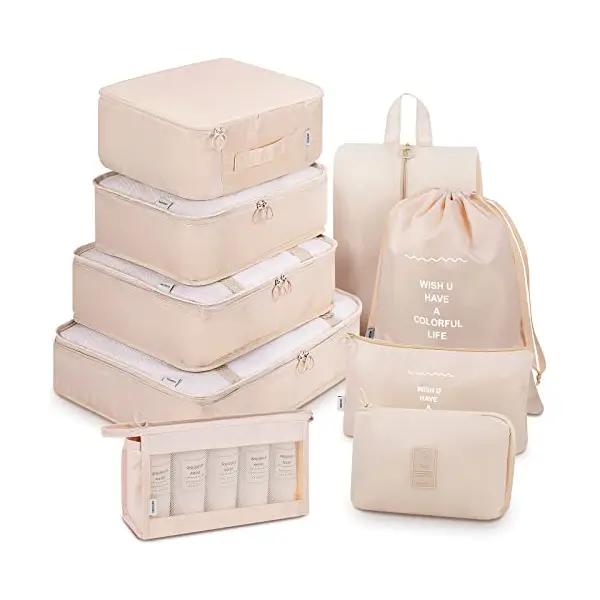
| Ready-to-ship set | Bestselling sets like our 9-piece travel organizer dispatch in 24 to 48 hours, with mixed styles and colors in one order. | Sellers testing listings before committing to a custom run, or those who need stock with a logo added in 3 to 7 days. | Programs that require proprietary dimensions, fabrics or retail packaging; that path is private label. |
Compression or vacuum: the difference that matters
Buyers confuse these two constantly. The confusion costs money. Here is the mechanical difference in plain terms.
Compression uses a second zipper. Close the main zipper, then close the compression zipper around the gusset. The gusset folds away as that zipper travels, pulling both panels toward each other and forcing air out through the mesh top. No valve. No rolling. Just two zippers doing the work, which is why a quality second zipper and reinforced corner bartacks matter so much on this style.
Vacuum uses an air path. You fill the cube, seal it, and press or roll. Air leaves through a one-way valve, a vent panel, or a roll-out design, depending on the project. The cube stays flat because the air cannot return. That makes vacuum the right call for down jackets, fleece and sweaters, the items that trap so much air that zipper compression gives up before the job is done.
When is each the wrong choice? Compression is the wrong pick for the bulkiest soft goods; the squeeze is visible but limited by fabric and contents. Vacuum is the wrong pick when unit cost is the whole conversation, because sealing zippers and coated polyester or nylon cost more than a standard coil zipper on a mesh-top cube. We prototype both so you can feel the difference before you commit.
What you choose before we quote
Every packing cube program starts with the same set of decisions. These choices change tooling, cost and lead time, so we ask them before we quote.
Fabric. Ripstop nylon for weight, polyester for cost, rPET for sustainability positioning. Mesh panel size is a design choice, not a fixed spec, and it shifts both the look and the airflow behavior.
Zippers and seams. Standard coil zippers cost less. Two-way YKK zippers are available on production sets. Compression styles need reinforced corner bartacks where load concentrates. Vacuum styles need a sealing zipper if you want the vacuum to hold.
Size and pattern. Start from your spec, or from our proven four-size system for compression cubes. Backpack cubes are patterned against your actual backpack model, so send interior dimensions or a physical sample.
Color and branding. Pantone-matched dyeing within a Delta E of 2.0. Woven labels, metal plates, heat-press PVC, laser and reflective logo processes all carry different MOQs.
Packaging. Six options from plain poly bag to gift box with handle bag, plus branded poly mailers and hang tags for marketplace-ready units.
Terms. Payment by T/T, L/C, D/P and D/A, credit card, PayPal, MoneyGram or Western Union. Full custom production runs 7 to 15 days after sample approval for standard constructions. MOQs depend on fabric and set composition. Low MOQs, contact us.
Start with the compression or vacuum style pages if you want the engineering detail. See backpack-specific cubes for tapered patterns. Review the 9-piece set for a ready-to-ship option. Or go straight to wholesale terms and contact us with your spec.
Have a different set in mind?
We pattern new sizes and compositions from your sketch or reference sample.
Get a Quote