Packing Cube Fabric Guide: Nylon, Polyester and Mesh
Packing cube fabric is the first thing a buyer notices. It drives weight, packability, compression, print quality and price. A cube that looks sharp online can feel cheap in hand if the shell was chosen wrong. And a shell that feels premium can kill margin if it's over-specified for a budget travel line.
Most cubes on the market use nylon or polyester, often with a mesh panel. The differences between those materials are real. They show up in hand feel, tear resistance, water behavior and how well a logo prints. This guide walks through what actually matters when you're writing a spec sheet for a packing cube program.
Let's start with the two main shell fabrics.
Nylon vs Polyester for Cube Shells
Nylon and polyester are both synthetic, both woven, both widely available. But they don't behave the same. Nylon has more stretch under load. It recovers well. It tends to feel softer and quieter when a zipper runs through it. Polyester has less stretch, better UV resistance and dries faster. It also costs less in most weights.
For a compression packing cube, that stretch difference matters. A compression zipper pulls the top and bottom panels toward each other. The shell takes repeated tension every time the user closes it. Nylon gives a little. Polyester resists. Neither is wrong. The choice depends on how firm you want the finished cube to feel.
Say a buyer wants a soft, malleable cube that stuffs into a backpack pocket. Nylon reads softer. Say the same buyer wants a structured cube that holds its shape on a shelf. Polyester, especially in a heavier denier, reads firmer. Same cube design, different fabric, different product.
What Denier and GSM Actually Tell You
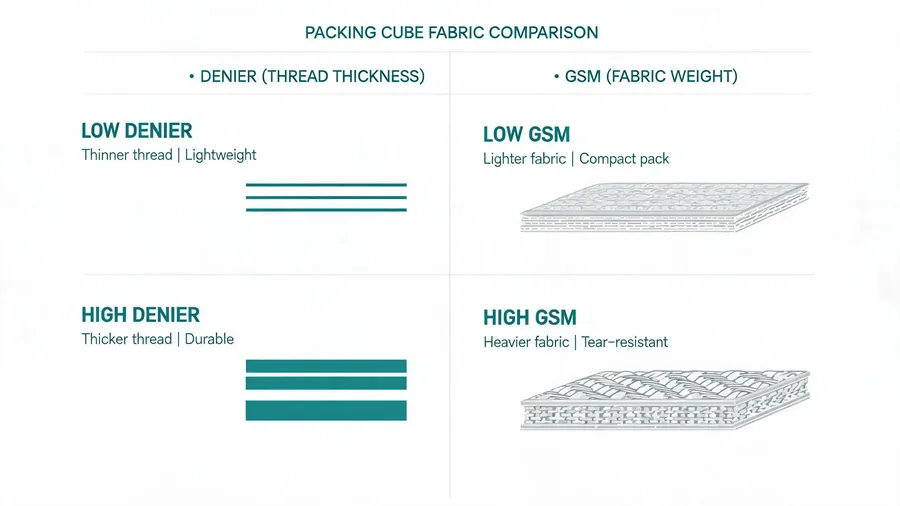
Denier is a yarn linear-density unit. It describes the thread, not the finished fabric strength. A 210D nylon and a 210D polyester are not automatically equal in tear resistance. Weave, coating and yarn quality all shift the result. That's why two factories can quote the same denier and deliver different hand feel.
GSM is grams per square meter. It's the mass of the finished fabric, film or composite per area. GSM gives you a better sense of how heavy and dense a cube will feel. Denier tells you about the yarn. GSM tells you about the fabric. Both belong on a spec sheet. Neither replaces a physical sample.
A buyer who orders 3,000 cubes in three colors should request a fabric swatch card before bulk. Bend it. Rub it. Load a sample cube and pull the zipper hard. That test tells you more than any spec line.
Coatings and Laminations
Most packing cube shells get a coating or lamination. It changes water resistance, stiffness, print surface and price. Polyurethane coating is common. It improves water resistance and gives a slightly softer hand. Polyvinyl chloride coating is stiffer and more moisture-resistant, but it's heavier and less breathable.
Thermoplastic polyurethane film is another option. It's used for waterproof laminates and welded constructions. A TPU-laminated cube can be fully welded at the seams, which eliminates stitch holes. That's useful for a wet gear cube or a toiletry-style organizer. But it costs more and adds stiffness.
Water resistance is worth the cost only if your customer needs it. A gym cube that sits next to a damp towel? Yes. A packing cube for backpacks that lives inside a dry pack? Probably not. Extra coating means extra weight and a higher price. Don't pay for a feature your buyer won't feel.
Mesh Types and Where They Help
Mesh is an open structure used for ventilation, visibility, stretch pockets or lightweight organization. On a packing cube, mesh usually appears as a top panel or a side panel. It lets the user see what's inside without opening the cube.
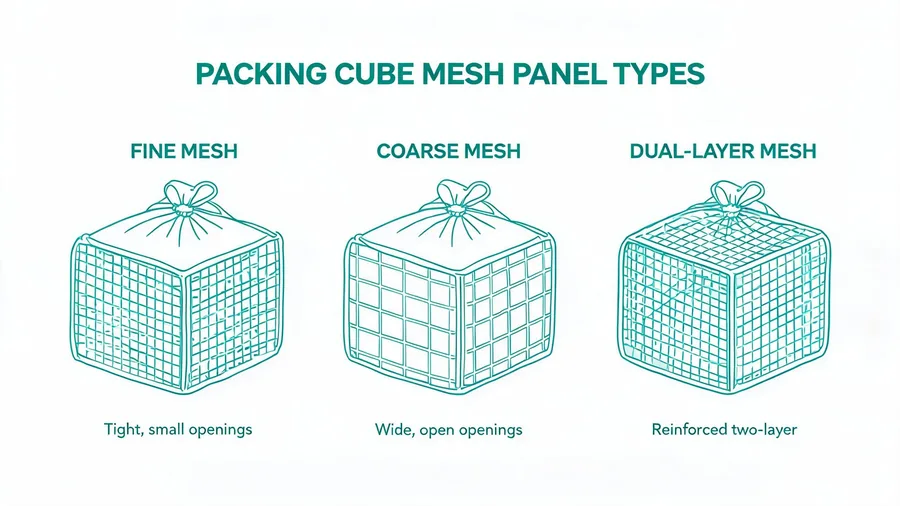
That visibility is the main selling point. A traveler who packs five cubes wants to find socks without unzipping three of them. Mesh solves that. It also adds breathability, which matters for damp clothes or shoes.
But mesh has downsides. It's less abrasion-resistant than a solid weave. It snags on zipper pulls and keys. It offers almost no water resistance. And it limits print area. If your brand logo needs a large, clean surface, a full mesh top panel won't work.
Common mesh choices include fine polyester mesh for visibility and heavier spacer mesh for structure. Spacer mesh is a three-dimensional textile that provides cushioning and airflow. It's overkill for most packing cubes. Fine mesh is the workhorse.
Recycled Options and Lining Choices
Recycled polyester, often called rPET, is widely available in cube-appropriate weights. It prints well and performs close to virgin polyester. Some buyers specify it for sustainability claims. Others skip it because the price premium doesn't fit a budget line.
Linings are the forgotten layer. A light polyester taffeta lining hides seam allowances and gives the interior a cleaner look. A nonwoven backing adds stiffness but can feel cheap if it's too thin. For a premium cube, a smooth woven lining in a contrasting color does a lot of work. It makes the cube feel finished when the user opens it.
Imagine a cube with a great shell and a raw, frayed interior. The customer sees that on day one. The lining is not the place to save ten cents.
How Fabric Interacts with Compression and Packability
Compression and packability are not the same thing. A compression cube uses a second zipper to squeeze the load. A packable cube is just lightweight and easy to fold flat. Fabric choice affects both.
For compression, you want a shell with enough body to hold the gusset shape when the compression zipper closes. Too soft, and the cube collapses unevenly. Too stiff, and the zipper fights the user. Ripstop nylon in a mid-weight is a common choice. The reinforcement grid limits tear propagation without adding much weight.
For packability, weight is king. A 30D or 50D nylon cube folds down to almost nothing. It won't hold a crisp shape, but it disappears in a daypack. That's the trade. Lightweight cubes feel flimsy on a shelf. Structured cubes feel premium but add grams to a traveler's load.
Print method also depends on fabric. Solid polyester takes dye sublimation well. Nylon can be printed, but the results vary by coating and color. Mesh doesn't print at all. If your brand relies on all-over prints, polyester is the safer base.
Fabric Selection by Product Positioning
The table below is a starting point. It's not a promise. Real performance depends on the tested specification, the coating and the factory's sewing quality.
| Product positioning | Shell suggestion | Mesh | Coating | Notes |
|---|---|---|---|---|
| Budget travel set | 190T polyester | Fine mesh top | Light PU | Low cost, prints well, limited structure |
| Mid-range organizer | 210D ripstop nylon | Fine mesh top | PU | Good tear resistance, soft hand, decent compression |
| Premium compression cube | 420D nylon or 600D polyester | Optional side panel | PU or TPU | Firmer structure, higher price, stronger zipper pull |
| Wet/dry cube | TPU-laminated nylon | None | TPU lamination | Welded seams, waterproof, stiffest option |
| Ultralight cube | 30D, 50D nylon | Fine mesh | None or light | Minimal weight, minimal structure, snag-prone |
This is a framework, not a rulebook. A buyer who wants a structured budget cube can use 210D polyester. A premium line might skip mesh entirely for a cleaner print surface. The spec follows the positioning.
Getting Samples Right
Order samples before you commit. That's the whole advice. Ask for the exact fabric, coating and mesh you plan to use. Test the zipper with the cube overstuffed. Rub the shell against a rough surface. Fold it. Crumple it. Leave it in a hot car for an afternoon.
One sample tells you more than a hundred spec sheets. If the fabric feels wrong in your hand, your customer will feel it too. Change the spec before you pay for tooling.
For more on cube construction and sizing, see our packing cube size guide and the compression bags vs packing cubes comparison. If you're ready to spec a line, contact us with your target positioning and we'll walk you through fabric options.
Frequently Asked Questions
What is the best fabric for packing cubes?
It depends on positioning. Ripstop nylon in 210D is a strong all-rounder for compression cubes. Polyester in 190T or 210D costs less and prints better. For ultralight cubes, 30D to 50D nylon wins on weight. Get samples and test them against your target price.
Does higher denier mean a stronger packing cube?
Not automatically. Denier describes yarn thickness, not finished fabric strength. Weave, coating and yarn quality all matter. A 210D ripstop can outperform a plain 420D weave. Always test a swatch rather than buying on denier alone.
Should packing cubes be waterproof?
Most don't need to be. A light PU coating handles splashes. Full waterproofing with TPU lamination and welded seams adds cost and stiffness. It's worth it for wet gear cubes or toiletry-style organizers, not for general clothing cubes.
Can I print a logo on mesh packing cube panels?
No. Mesh doesn't take print. If your brand needs a large logo area, use a solid polyester panel and keep mesh to a smaller side or top window. Solid polyester also handles dye sublimation better than most nylon.