Compression Packing Cubes for Travel: A Real Trip Guide
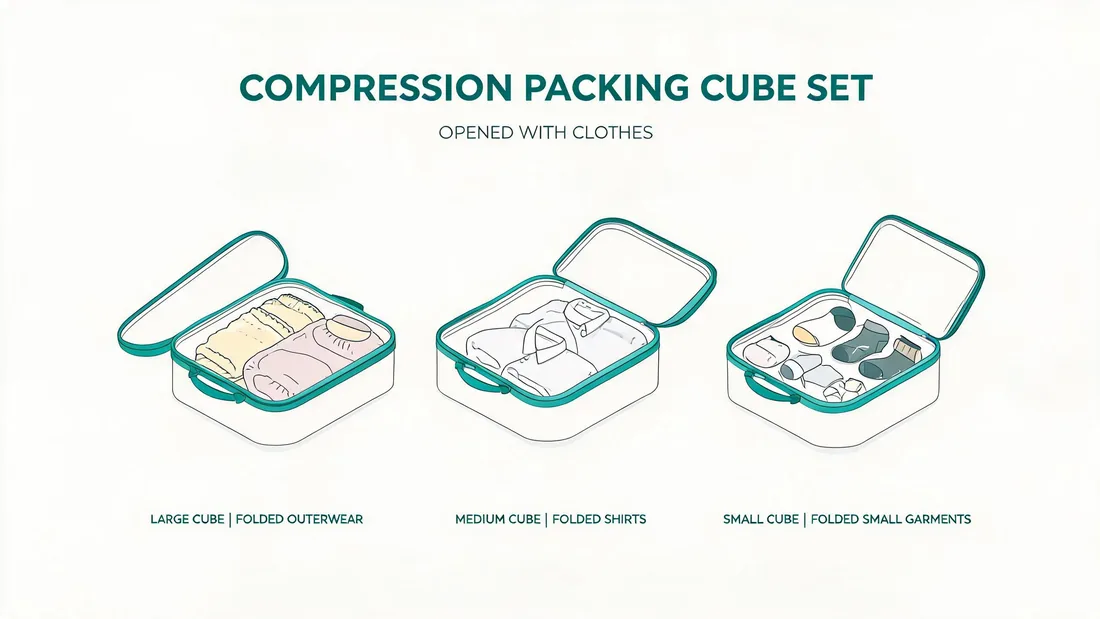
Compression packing cubes for travel are not vacuum bags. They don't remove air. They don't make your clothes lighter. What they do is squeeze soft items into a smaller shape so you can fit more into the same carry-on. That distinction matters more than most buyers expect, especially when the cube meets an airline weight limit.
A buyer ordering 800 units in three colors will ask us the same question a traveler asks at the gate. Does the second zipper actually save space? Yes. But only for the right kind of contents, and only if the cube is built to survive being yanked shut fifty times a year.
How the second zipper actually works
A compression cube has one zipper to close the top panel. A second zipper runs around the body or across the side. Close that second zipper, and it pulls the lid toward the base around the packed contents. The fabric gusset between the two panels folds inward. The cube gets shallower.
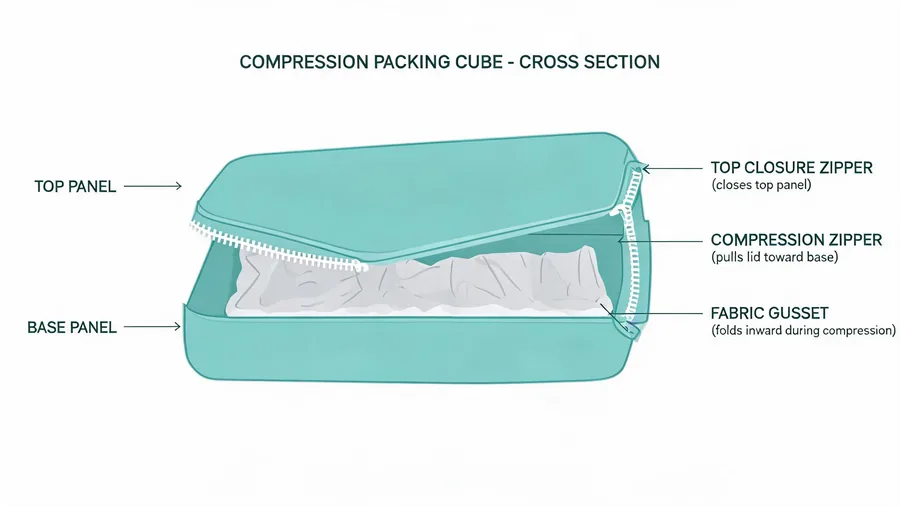
This is mechanical compression. There is no pump. The cube doesn't need to be airtight. The pressure comes from the zipper taking up fabric that would otherwise stay open as depth.
What compression does not do is reduce weight. A five-pound pile of sweaters still weighs five pounds after you cinch the cube shut. This is the single most important thing to understand for hand-luggage travel. Many airlines enforce both a size limit and a weight limit. A compression cube can fix the size problem. It cannot fix the weight problem. If your carry-on is over the weight allowance, no amount of zipper pulling will help. You will still be charged at the gate.
Compression also cannot create space beyond the cube's packed volume. It only removes the air gaps between soft items. Pack a cube with hard objects and the second zipper has nothing to compress. Pack it with knits and the same cube can lose a noticeable amount of height.
One more thing. Compression works best when the cube is full enough to resist the zipper. A half-empty cube will just wrinkle inward unevenly. Fill it to about three-quarters, then cinch.
What to pack in compression vs regular cubes
Compression suits soft, flexible items. Knits, t-shirts, underwear, socks, activewear, leggings, and lightweight fleece all squash well. These fabrics have give, so the pressure distributes across the load instead of creasing one sharp fold.
Regular cubes suit structured items. Blazers, dress shirts, trousers, anything with a collar or a pressed crease belongs in a non-compression cube. The same goes for items you need to arrive looking finished. A compression zipper will press a folded dress shirt into a tight brick. It will come out with lines that no hotel iron wants to meet.
Avoid over-compressing delicate or structured garments. A silk blouse under full compression is a gamble. A wool blazer under full compression is a mistake. Use compression for bulky but squashable layers. Leave the structured pieces in a standard cube or on top of the bag.
Here is a simple rule we tell buyers. If you would sit on it without worrying, it can go in a compression cube. If you would hang it up, it cannot.
Fold or roll: which works better in a compression cube
Rolling tends to distribute pressure more evenly than folding. A rolled t-shirt is a cylinder. The compression zipper presses on the rounded surface, not on a single crease line. That reduces the chance of deep set-in wrinkles.
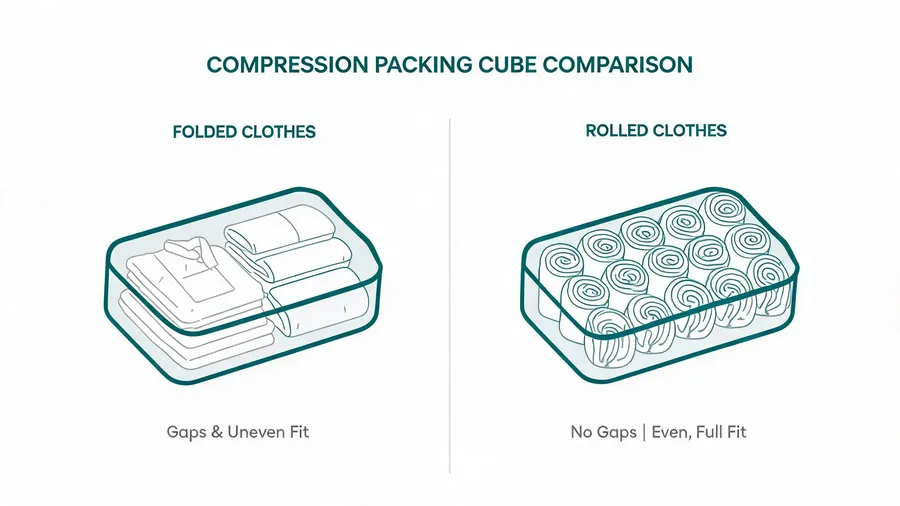
Folding creates flatter layers. That is useful for maximizing the number of items per cube, but it can crease more under the compression zipper. A folded shirt has a defined fold line. Compression presses directly on that line.
The best method depends on fabric type and cube size. Soft knits roll well. Stiffer woven fabrics fold more predictably. A hybrid approach works for most travelers. Roll soft items like t-shirts and underwear. Fold stiffer items like jeans or chinos. Place the folded pieces on the outside edges of the cube where they receive less direct pressure.
For a deeper look at how cubes compare to other compression methods, see our compression bags vs packing cubes breakdown.
Organising a carry-on by cube
Assign one cube per clothing category or outfit group. Don't mix socks, shirts, and chargers in one cube. You'll unpack the whole thing at security. A better system is one cube for tops, one for bottoms, one small cube for underwear and socks.
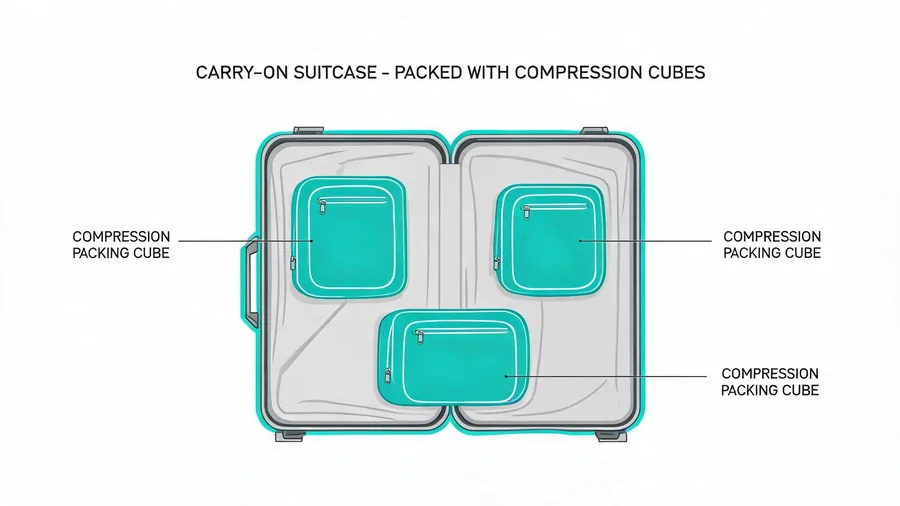
Place heavier or less-used cubes at the bottom of the bag. This keeps the carry-on stable and puts the items you need in transit at the top. Keep a small cube for in-transit access: a sweater, a phone charger, a book. Keep a separate pouch for toiletries. Liquids and compression don't mix well, and you'll need to pull that pouch out at security anyway.
Use cube dimensions to check carry-on fit without quoting airline-specific limits. Different airlines publish different maximum dimensions, and they change. Check the current guidance from the airline you are flying before you pack. The principle is simple: measure your packed cubes, not your empty bag. A cube that fits in an empty carry-on may not fit once the bag is full. For a closer look at sizing, read our packing cubes size guide.
Fabrics and zippers that survive repeated compression
Compression puts real stress on seams and zippers. The second zipper is under tension every time you close it. If the fabric or the zipper is weak, the cube fails at the seam, not at the panel.
Ripstop and higher-denier nylon or polyester resist seam stress during compression. Ripstop has reinforcement yarns arranged in a grid, which limits tear propagation if a seam starts to pull. Higher-denier fabrics give the seam more material to hold onto. Coated fabrics and reinforced seams help the cube keep its shape after dozens of compression cycles.
Name-brand or smooth-running zippers are less likely to catch or fail. The compression zipper is the hardest-working part of the cube. A cheap zipper will catch on the gusset fabric and jam. A good zipper glides even when the cube is overstuffed. When you evaluate a cube, open and close the compression zipper ten times before you buy it. If it catches once, it will catch more later.
Mesh panels aid visibility but may be less abrasion-resistant. A mesh top lets you see what is inside without opening the cube. That is useful. But mesh is thinner than solid fabric and can snag on other items in the bag. If you pack cubes tightly against each other, a solid-panel cube will usually outlast a mesh-panel cube.
For a buyer-focused breakdown of what makes a cube survive, see our compression packing cubes page.
Wrinkle trade-offs and how to reduce them
Compression increases pressure on folded or rolled garments. That is the trade-off for saving space. You cannot have a fully compressed cube and a wrinkle-free dress shirt in the same package.
Softer knits recover better than crisp woven fabrics. A cotton t-shirt will shake out and look fine. A poplin shirt will not. The difference is in the fiber and the weave, not in the cube.
Packing fewer items per cube reduces deep creasing. A cube stuffed to the absolute limit will crease everything inside it. A cube packed to three-quarters will still compress, but the pressure is lower and the wrinkles are shallower.
Unpacking or hanging clothes soon after arrival limits set-in wrinkles. The longer a compressed garment stays folded, the more the crease sets. Hang shirts and trousers as soon as you get to the hotel. For most travelers, ten minutes of hanging beats an hour of ironing.
Trip-type cube mix: weekend, one-week, two-week
The right cube mix depends on trip length and laundry plans. A weekend trip needs fewer cubes. A two-week trip with no laundry access needs more. Here is a practical starting point.
| Trip length | Suggested cube mix | What goes in each |
|---|---|---|
| Weekend | 1 small + 1 medium | Small for underwear and socks, medium for tops and one pair of trousers |
| One week | 1 small + 1 medium + 1 large | Small for underwear and socks, medium for tops, large for bottoms and a sweater |
| Two weeks | 2 medium + 1 large + 1 laundry or shoe cube | One medium for tops, one medium for bottoms, large for bulkier layers, laundry cube for worn items |
This is a starting point, not a rule. If you travel with a laptop, add a separate padded sleeve. If you travel with a suit, add a non-compression garment folder. The goal is to assign every item a home so you never dig through the whole bag.
For more on how cubes fit into a backpack, see our packing cubes for backpacks guide.
What to ask any supplier before you order
If you are sourcing compression cubes for a brand, the questions are different from a traveler's questions. Ask about the fabric denier and GSM. Ask whether the compression zipper is a branded component or a generic one. Ask for a sample and run the zipper fifty times. Ask whether the seams are reinforced at the gusset corners, because that is where compression cubes fail first.
Ask about the foam or stiffener if the cube has one. Some compression cubes use a thin plastic board in the base to keep the shape. Others rely on fabric tension alone. Both can work, but they feel different in the hand and they age differently.
Ask about the coating. A coated fabric resists moisture and wipes clean, but it can crack at the fold lines after repeated compression. An uncoated fabric breathes better but stains more easily. There is no perfect answer. There is only the answer that matches your customer.
Camytonc can discuss fabric weights and material options such as nylon, polyester, canvas, and rPET. We offer 24-hour response and replacements or credits for after-sales issues. You can reach us by email at [email protected].
For a step-by-step packing method, read how to use packing cubes.
Frequently Asked Questions
Do compression packing cubes really work?
Yes, for soft items. The second zipper pulls the lid toward the base and removes air gaps between knits, t-shirts, and underwear. They do not reduce weight, and they do not work well on hard or structured items.
Is it better to fold or roll clothes in compression packing cubes?
Rolling usually works better because it distributes pressure evenly and reduces sharp crease lines. Folding can create flatter layers but may crease more under the compression zipper. A hybrid approach works well: roll soft knits, fold stiffer woven items.
What should you not pack in compression cubes?
Avoid structured garments like blazers, dress shirts, and trousers with pressed creases. Also avoid delicate fabrics like silk and anything with sharp edges that could damage the cube. Liquids and toiletries belong in a separate pouch.
How much space do compression packing cubes actually save?
The amount varies by fabric type and how full the cube is. Soft, airy items compress more than dense woven fabrics. A realistic expectation is a noticeable reduction in packed height, not a 50 percent miracle. The exact amount depends on your load and the cube's design.