Packing Cubes for Carry-On Luggage: Sizing That Fits
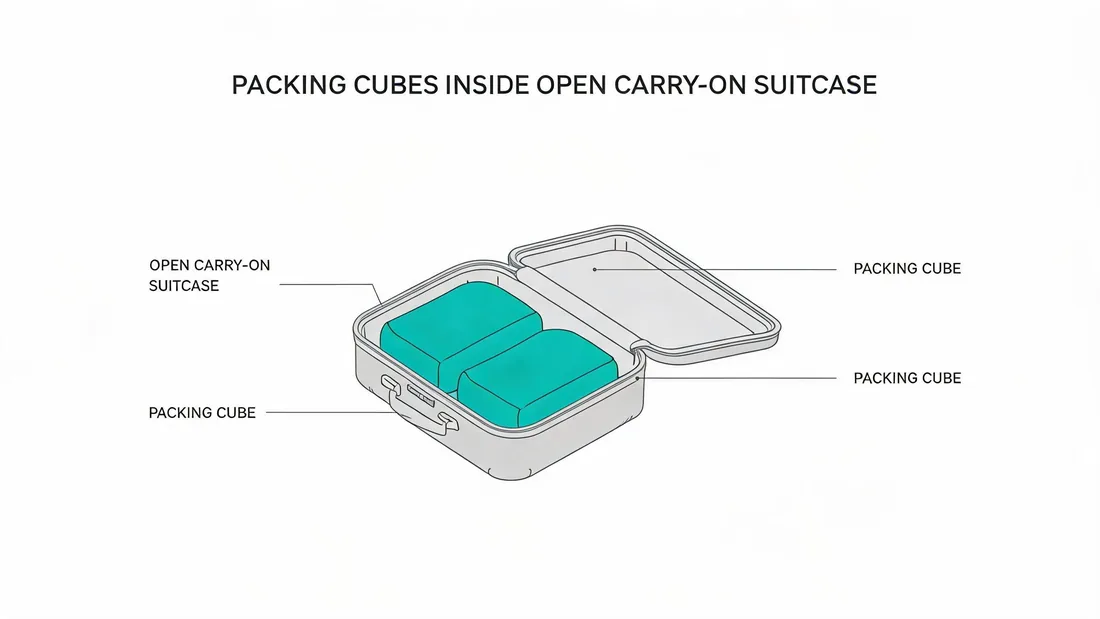
Packing cubes for carry on luggage fail for one reason most of the time. The set is sized to the bag's external dimensions, not the usable interior. A carry-on that measures 22 inches tall on the outside does not give you 22 inches of packing height inside. Wheels, a telescoping handle, frame sheets, and curved corners all eat space. So the cubes arrive, look right, and then don't tile. You end up with a hard brick in one corner and dead air everywhere else.
This guide is for two kinds of readers. The traveler who wants a set that actually works. And the brand buyer planning a carry-on oriented cube line. The logic is the same. You plan from the inside out.
Why External Dimensions Lie
Every carry-on has an interior that is smaller and stranger than the spec sheet suggests. The manufacturer's listed size is the maximum external envelope. It includes wheels, the handle housing, and the shell thickness. The usable cavity is narrower at the bottom where the telescoping handle rails run. It's shallower at the top where the lid curves. It's not a clean rectangle.
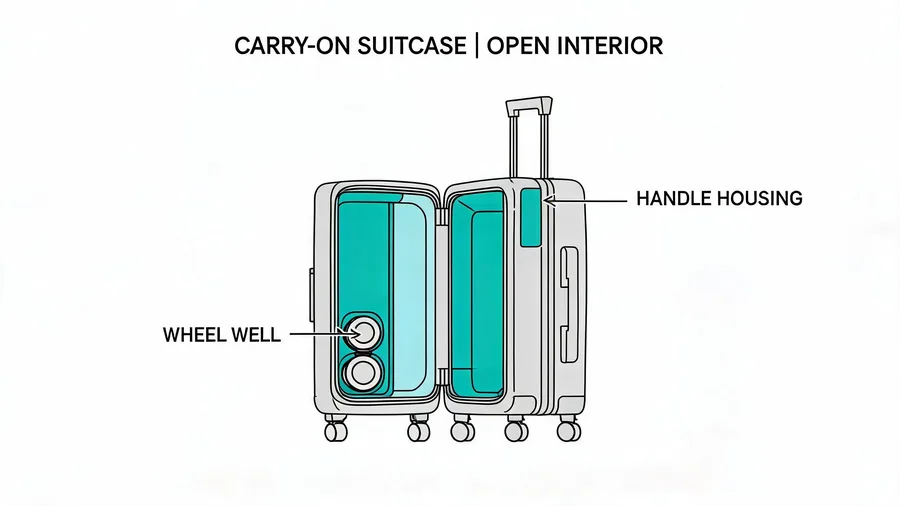
Say a buyer specs a cube set for a bag listed at 22 x 14 x 9 inches. The actual flat packing area might be closer to 20 x 13. And the depth is not uniform. A large cube sized at 14 x 10 x 4 inches will not sit flat. It will ride up one side and block the closure. The fix is not a smaller cube. The fix is a different shape.
Measure the bag's floor panel. Measure the height from the floor to the top of the handle rails, not to the lid. Then subtract a little for zipper slack and fabric bunching. That's your real working volume. A good cube set is designed around that, not around the airline's published maximum.
The Tiling Principle
Cubes should behave like floor tiles, not like boulders. A set tiles when the cubes share straight edges and fill the floor panel without forcing gaps. The classic mistake is mixing three random sizes from a catalog. A medium cube and a small cube from different product lines will not share a common dimension. So they leave a wedge of unusable space between them.
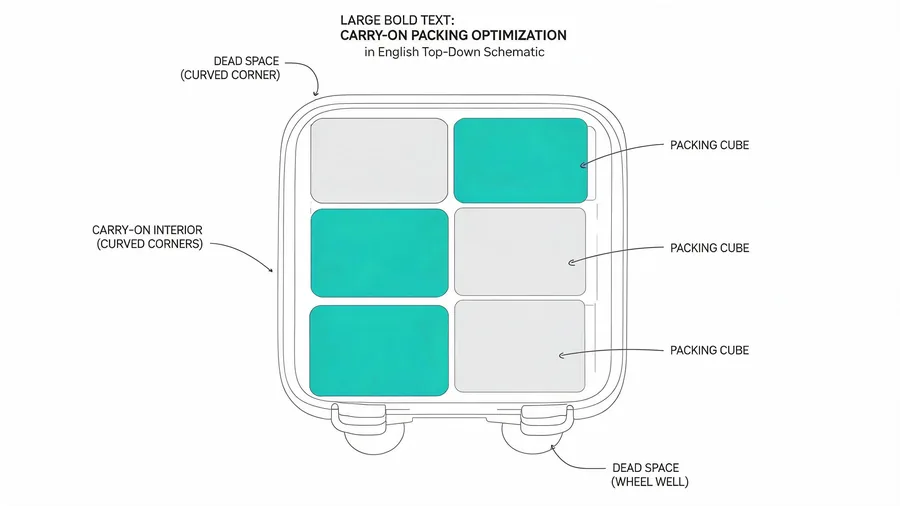
Plan the set on a grid. Start with the floor panel's width. If the usable width is 13 inches, a 13-inch wide cube works once. Two 6.5-inch cubes work better because they let you split categories. Three 4.3-inch cubes are too narrow for most folded shirts. The grid forces you to make choices.
Here is a practical set-planning table for a typical 22-inch carry-on:
| Set composition | Cube dimensions (inches) | Best for | Main weakness |
|---|---|---|---|
| One large + one medium | 13 x 10 x 4 and 13 x 6.5 x 4 | Couples, bulk packing | Hard to split categories |
| Three mediums | 13 x 6.5 x 4 each | Solo travelers, outfit grouping | Less depth for bulky items |
| Two mediums + two smalls | 13 x 6.5 x 4 and 6.5 x 6.5 x 4 | Mixed trips, tech and toiletries | More zippers, more weight |
| One large + four slims | 13 x 10 x 4 and 13 x 3.25 x 2 | Shirts, trousers, flat items | Slims hold almost nothing bulky |
These dimensions are not a promise. They are a starting grid for a bag with a 13-inch usable floor width. Your bag's floor panel decides the real numbers. The point is the relationship: the cubes share one dimension, so they tile.
One Big Cube or Several Small Ones?
A single large cube is fast. You dump everything in, zip it, and go. It also wastes the most space. Because the cube becomes a rigid block, and the bag's curved corners stay empty. It's also a nightmare at security if you need one item from the bottom.
Several small cubes are slower to pack but faster to live out of. You can pull one cube without disturbing the rest. You can move a cube to a daypack without repacking. You can wash one category without contaminating the others.
The trade-off is weight and zipper count. Every cube adds fabric and a zipper. On a 7 kg airline limit, that matters. A set of four cubes might weigh 300 grams. A single large cube might weigh 120 grams. For a brand buyer, the question is which customer you're serving. The minimalist wants one cube. The organizer wants four. Sell both, but don't pretend they solve the same problem.
Where Compression Helps, and Where It Doesn't
Compression cubes reduce bulk by pulling the top and bottom panels closer. They work best on soft, springy loads: fleece, sweaters, t-shirts, underwear. The fabric gives, the cube shrinks, and the load stays compressed. You see the benefit in the bag's upper section, where you need clearance for the lid to close.
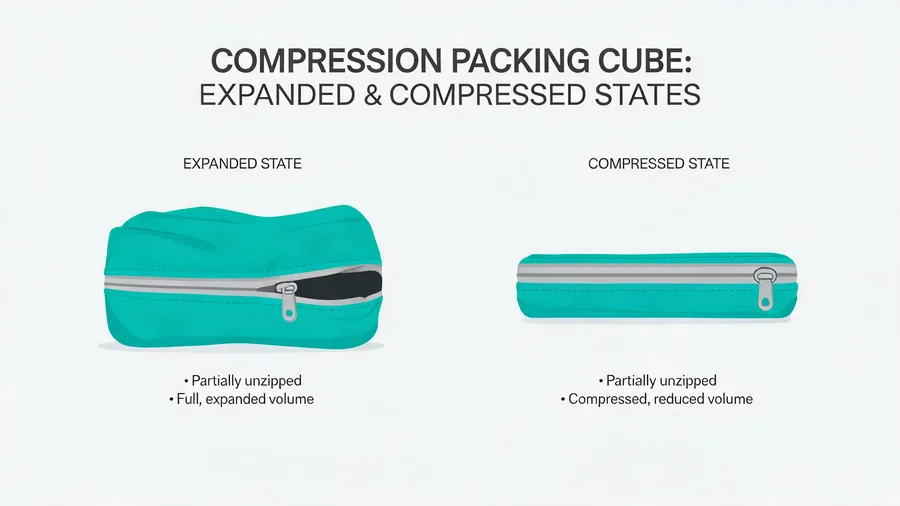
Compression does nothing useful on hard, inelastic items. Jeans, shoes, toiletry bottles, electronics. Those don't compress. They just push back. The cube becomes a hard brick with a strained zipper. Worse, over-compressing soft clothes creates a dense loaf that is heavy and awkward to carry. It fits, but it doesn't help.
A buyer who packs mostly knitwear will love a compression packing cube. A buyer who packs mostly denim and shoes will not. The honest answer is that compression is a feature, not a universal upgrade. If you're planning a carry-on set, put compression on the clothing cubes only. Leave the toiletry and shoe cubes non-compression. That's the practical split. For a deeper look at how the mechanism works, see our compression cube guide.
Building a Routine That Works
Most people pack by category. Shirts in one cube, trousers in another, underwear in a third. That works until day three, when you need one clean shirt from the bottom of the shirt cube and everything comes out. The alternative is outfit packing. One cube holds a full outfit: shirt, trousers, underwear, socks. You grab one cube, you're dressed. It's brilliant for short trips. It's terrible for long ones, because you end up with five cubes that each hold one outfit.
Laundry handling changes the math. If you plan to wash clothes on the trip, you need a dedicated dirty laundry cube. It can be a simple drawstring pouch or a lightweight cube with a mesh top. The key is separation. Clean clothes never touch dirty ones. A shoe bag is non-negotiable. Shoes carry grit, and grit migrates. A separate toiletry cube keeps leaks contained. It also makes the security screening easier if your liquids are in one removable cube.
For backpack-style carry-ons, the same tiling logic applies, but the shape is different. A backpack is deeper and narrower than a roller. Cubes for backpacks need to be taller and slimmer. We cover that in packing cubes for backpacks.
Airline Limits Are a Moving Target
Carry-on size limits vary by carrier. They also vary by fare class and route. Some airlines enforce a 21.5-inch length. Others allow 22. Some weigh carry-ons. Most don't, but the ones that do will catch you at the gate. The cube set does not change the airline's rules. It only changes how efficiently you use the space you're allowed.
Check the carrier's current published limits before you buy or spec a set. The International Air Transport Association publishes a recommended maximum, but it is not binding. Airlines are free to set their own. If you're designing a cube set for retail, don't print "fits all carry-ons" on the packaging. It doesn't. Print the cube dimensions and let the buyer compare them to their own bag.
One more thing about the usable interior. A bag with a lot of internal organization, pockets, dividers, laptop sleeves, will fit fewer cubes. The organization itself consumes space. A clean, open cavity tiles best. If your customer uses a highly structured carry-on, sell them fewer, flatter cubes. If they use a simple duffel or clamshell, sell them a full grid.
Specifying a Carry-On Set for Your Brand
If you're a brand buyer, you need to decide three things before you contact a factory. First, the reference bag. What are the interior dimensions of the bag you're designing for? Second, the grid. Will the cubes share a common width, a common depth, or both? Third, the compression split. Which cubes get compression zippers, and which stay simple?
Don't spec a set by looking at a competitor's product photos. The photos won't show you the interior dimensions or the compression gusset design. Spec from the floor panel of a real bag. Then sample the set in that bag. If the largest cube doesn't sit flat on the floor panel, the grid is wrong. Fix the grid before you fix the fabric.
For a broader look at how cube dimensions work across travel styles, see our packing cube size guide. And if you're weighing compression against vacuum bags, the comparison is here.
Frequently Asked Questions
Here are the questions we hear most often from buyers planning a carry-on cube line.
Frequently Asked Questions
What size packing cubes fit a 22-inch carry-on?
It depends on the bag's interior floor panel, not the external 22-inch length. Measure the usable width and depth inside the bag. A common starting grid is cubes 13 inches wide, because many carry-on floor panels are around 13 to 14 inches wide. The depth should match the bag's height above the handle rails. Test the largest cube in the bag before finalizing.
Should I use compression packing cubes in my carry-on?
Use compression cubes on soft, springy items like knitwear and t-shirts. They don't help on jeans, shoes, or toiletry bottles because those items don't compress. Over-compressing soft clothes can create a heavy, dense block. The practical approach is compression on clothing cubes, non-compression on everything else.
How many packing cubes do I need for a carry-on?
For most travelers, three to four cubes work well. Two mediums for clothing, one small for underwear and socks, and one slim or non-compression cube for toiletries or shoes. The exact count depends on trip length and whether you pack by category or by outfit. More cubes means more weight and more zippers.
Do packing cubes save space in a carry-on?
Cubes save space by keeping items flat and letting you use the full floor panel without gaps. They don't reduce the volume of your clothes. Compression cubes can reduce bulk on soft items, but they add fabric weight. The main benefit is organization and the ability to pack a tight grid instead of a loose pile.