Packing Cubes for Duffel Bags and Backpacks
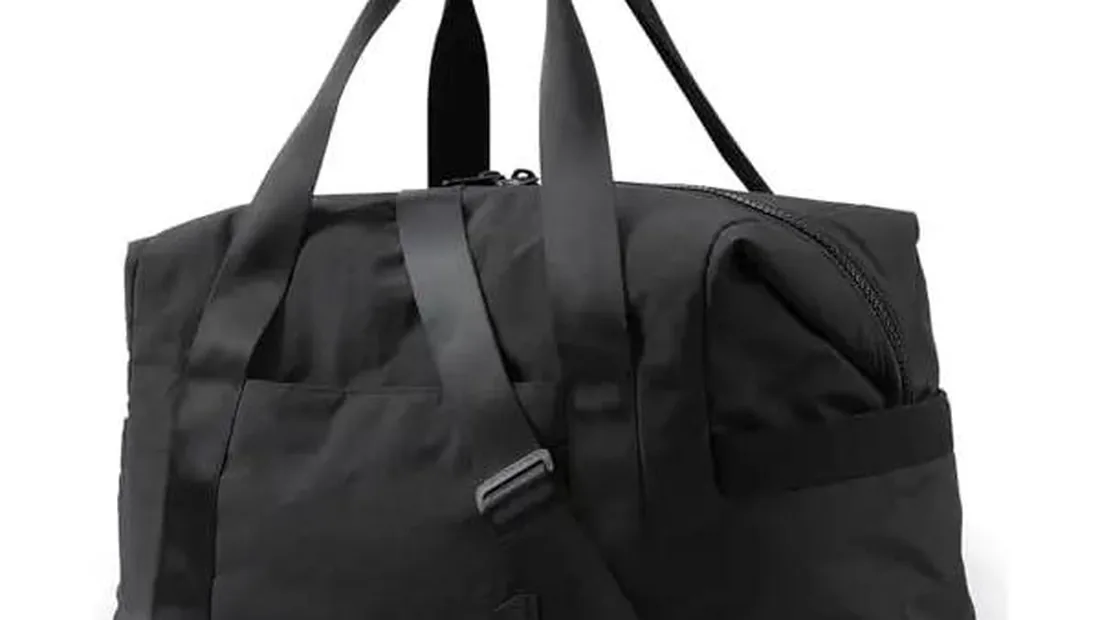
Packing cubes for duffel bags and backpacks behave differently than cubes in a hard carry-on. A rigid suitcase gives you a rectangular cavity with fixed walls. A duffel or backpack gives you a soft shell that changes shape as you load it. The cube has to do part of the work the bag frame would normally do.
Most buyers test their first set in a rolling case and assume the same sizes will transfer. They don't. The same cube that slides neatly into a 22-inch spinner can jam in a 40-liter top-loader or leave dead space in a panel-opening pack. The fix starts with how you measure the bag.
Measure the Bag, Not the Marketing Photo
Soft bags are photographed empty and often stuffed with paper for the product shot. That shape is not the shape you will pack. A duffel with a listed width of 14 inches may have usable interior width closer to 11 inches once the side panels curve inward and the zipper track eats an inch on each side.
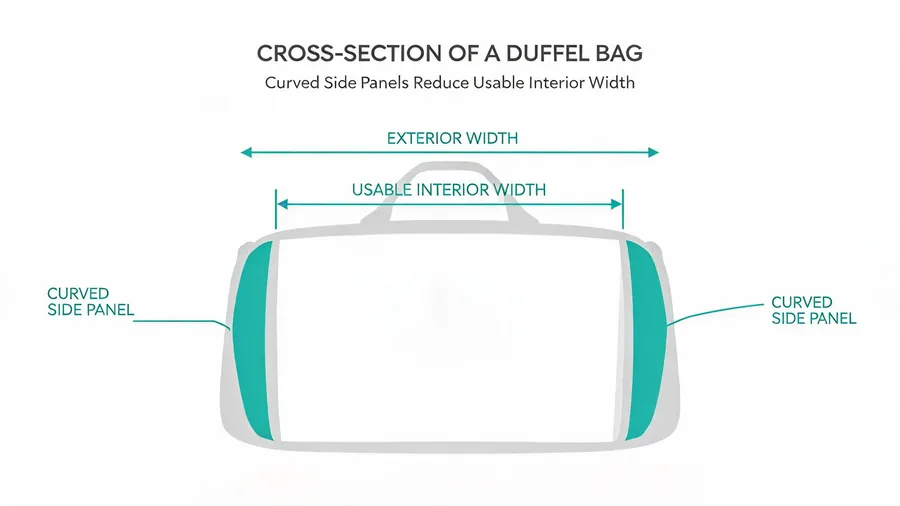
Measure the bag at the narrowest point you actually pack through. For a top-loading backpack, that means the opening circumference and the shoulder-width of the main compartment. For a duffel, measure the flat bottom panel and the height of the side walls before they start to taper. Then subtract for seams, zipper tape, and the fact that soft fabric bulges.
One practical starting point: a cube that is roughly five to eight percent narrower than the bag's stated width often settles well in a tapered soft interior. Treat that as a starting point, not a rule. The better method is to measure the bag's actual interior at half-height, where the taper is already working against you.
Cube Shape Matters More Than Cube Volume
A packing cube is a fabric box with a zipper. But the shape of that box determines whether it loads cleanly through a small opening or fights you the whole way.
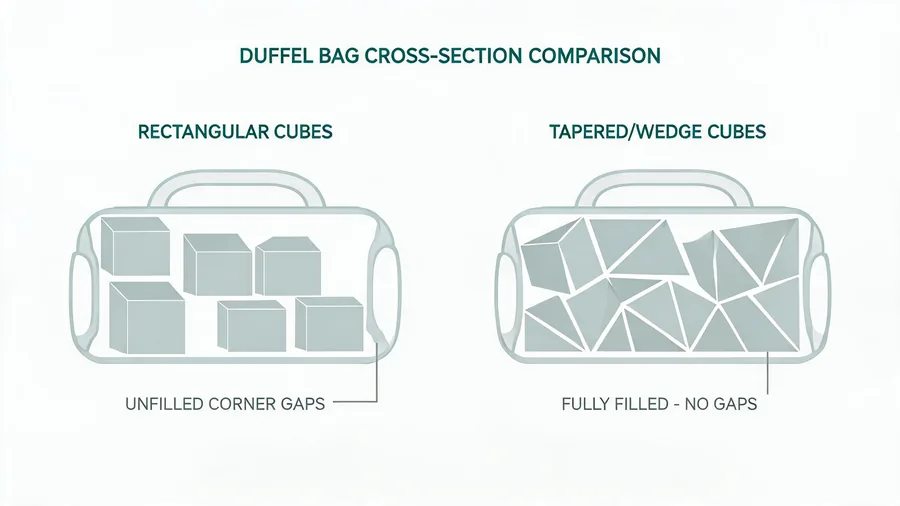
In a hard case, flat rectangular cubes stack like books. In a top-loading backpack, that flat shape becomes a problem. You have to push it through a narrow mouth, then turn it inside the pack. A tall, narrow cube drops in vertically and can be pulled out the same way. It behaves like a stuff sack with structure.
Panel-loading backpacks and duffels with a full-length zipper are different. There you can lay a flat cube in like a drawer and zip the lid over it. The cube's top panel becomes the packing surface. Two or three flat cubes side by side use the base area better than one tall cube.
The issue is not the cube by itself. The opening you have to feed it through decides the shape. A cube that is perfect for a clamshell suitcase can be the wrong tool for a top-loader.
Loading Order Changes How the Pack Carries
Backpacks carry best when dense weight sits close to the spine and high in the pack. Duffels carry best when the weight stays low and centered so the bag doesn't roll against your leg.
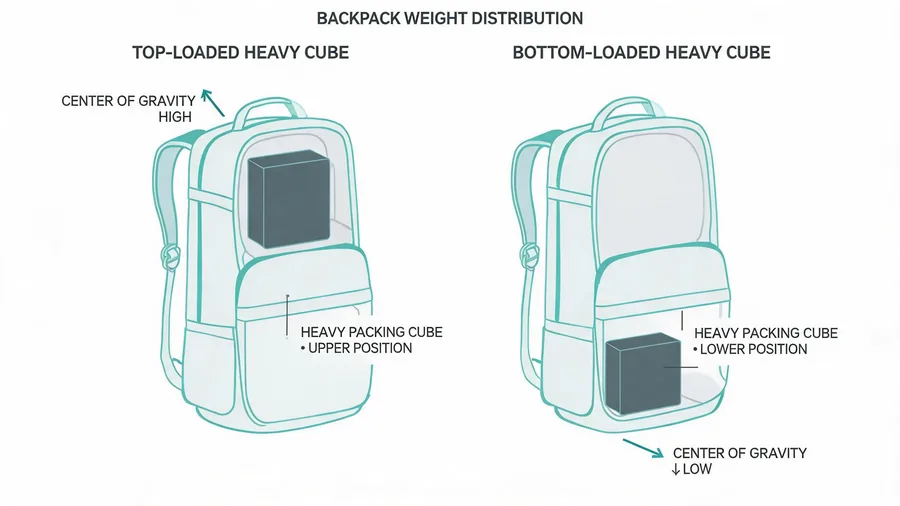
That means the same set of cubes gets loaded differently depending on the bag.
Top-loading backpack
- Bottom: light, bulky items like a down jacket or sleepwear in a compression cube.
- Middle, against the back panel: dense items like toiletries, electronics, or shoes in a firm cube.
- Top: mid-weight clothing you need during the day, in a cube you can pull without unpacking the whole bag.
Panel-loading backpack or duffel
- Bottom layer: flat cubes with heavy items, spread across the base.
- Middle layer: medium-weight cubes, placed over the heavy layer to keep the center of gravity low.
- Top layer: light cubes or loose items, so the bag closes without bulging.
In a duffel, the base panel is often the only structured part of the bag. Keep the heavy cubes there. If you put dense items in the top layer, the bag sags and the shoulder strap pulls into your hand.
Compression in a Soft Shell
Compression cubes reduce volume by pulling the top and bottom panels closer together. In a hard suitcase, that saved space is real because the shell doesn't give. In a soft bag, the story is more complicated.
When you compress a cube inside a duffel, the bag's fabric can simply bulge outward somewhere else. You haven't saved space. You've moved it. The benefit shows up when the bag is already near full and you're trying to close the zipper without forcing it. Compression then helps you get the last inch.
A better use of compression in soft bags is pre-compression. Compress the cube before it goes in. A cube that holds its compressed shape acts like a firm brick and stacks more predictably. That works well in duffels with a wide opening.
One caution: don't compress cubes that hold structured items like shoes or toiletry bottles. You'll distort the cube and make it harder to pack around. Save compression for clothing and soft goods. For more on how compression works mechanically, see our compression packing cubes guide.
Shoes and Wet Items on the Move
Shoes are the classic soft-bag problem. They're heavy, dirty, and awkwardly shaped. In a hard case, a shoe bag just sits in a corner. In a duffel or backpack, it slides around and ends up against your clean clothes.
Use a separate cube for shoes. A flat cube with a grab handle works in a duffel. A tall narrow cube works in a top-loader. Either way, the shoe cube should be firm enough to hold its shape when the bag is only half full. If it collapses, the shoes migrate.
Wet items need isolation. A damp towel or swimsuit in a standard fabric cube will transfer moisture to anything touching it. Use a cube with a coated liner or a dedicated wet bag. Some buyers order cubes with a clear TPU panel on one side so the user can see which cube holds the wet gear without opening it. That's a practical upsell for travel brands.
Place the wet cube where it can't touch electronics or paper. In a duffel, that means the end pocket or the top layer. In a backpack, the outer mesh pocket works if the cube has a waterproof liner. If it doesn't, keep it inside the main compartment but against the outer wall, away from the back panel.
Bag Type to Cube Format
The table below is a starting point for matching cube shapes to bag types. It assumes the cubes are custom-sized for the bag, not off-the-shelf universal sizes.
| Bag type | Opening style | Best cube format | Why |
|---|---|---|---|
| Top-loading backpack | Narrow top mouth | Tall, narrow cubes | Drops in vertically, no turning inside the pack |
| Panel-loading backpack | Full-length side or front zipper | Flat, rectangular cubes | Loads like a drawer, uses the full base |
| Duffel with U-shaped lid | Wide top opening | Flat cubes plus one tall cube for shoes | Flat cubes stack, tall cube holds shape at the end |
| Duffel with end zipper only | Small end access | Narrow cubes or stuff-sack style | Limited opening forces vertical loading |
| Weekender duffel | Wide top opening | Two or three flat cubes | Keeps layers visible and accessible |
This is a fit guide, not a universal law. The exact cube dimensions depend on the bag's measured interior and the user's packing style. Some people prefer many small cubes. Others want three large ones. The shape logic stays the same.
Fabric and Structure for Soft-Bag Cubes
A cube that goes into a hard suitcase can be made from fairly soft fabric. The suitcase walls hold everything in place. In a duffel or backpack, the cube itself has to resist being crushed and twisted.
Look for a semi-structured body. That means the side panels have some stiffness from foam, board, or laminated fabric, but the cube can still flex when you push it through an opening. The base panel should be the most structured part. A firm base keeps the cube from collapsing into a ball at the bottom of the pack.
The answer is not to make the whole cube rigid. A rigid cube fights you in a soft bag. Keep the side panels soft enough to compress and let the base panel hold the shape. That combination loads easily and still stacks.
Mesh top panels help in panel-loaders because the user can see what's inside without opening the cube. In a top-loader, a mesh panel is less useful because the cube is usually pulled out entirely. A grab handle on the top or side matters more there.
For more on choosing cube sizes for different bag types, see our packing cube size guide. If you're comparing compression cubes against vacuum bags, the trade-offs are covered in this comparison.
Common Mistakes When Specifying Cubes for Soft Bags
Ordering cubes that are too wide is the most common error. A buyer measures the bag's listed width and orders cubes to match. The cubes arrive and don't fit through the opening. The bag's interior taper and the zipper track were never part of the calculation.
Another mistake is ignoring the opening style entirely. A cube set designed for a clamshell suitcase gets reordered for a top-loading backpack because the volume is similar. The volume fits. The access doesn't.
Over-compression is a third issue. A buyer specs compression cubes for every item, including shoes and toiletries. The result is a set of hard, misshapen bricks that don't conform to the bag. Compression has a place, but it's not universal.
The choice between a tall cube and a flat cube is not about quality. It's about whether your customer packs through a hole or through a lid. Get that right and the rest of the set falls into place.
Bottom Line
Packing cubes for duffel bags and backpacks need to be specified for the bag's opening, not just its volume. Measure the interior at half-height. Match cube shape to access style. Load dense items low and close to the body or base. Use compression selectively, and keep shoes and wet gear in their own structured cubes.
A buyer ordering 500 cubes in three sizes for a duffel line should ask one question first: does the duffel open from the top or the end? The answer determines the entire set. If you're starting a custom cube project, tell us the bag model and we'll work through the fit together.
Frequently Asked Questions
Can I use regular packing cubes in a duffel bag?
Yes, but the shape matters. Flat rectangular cubes work well in duffels with a wide U-shaped opening. If the duffel only has a small end zipper, narrow cubes or stuff-sack style organizers load more easily.
Do compression packing cubes work in backpacks?
They work best when you compress the cube before putting it in the pack. Compressing inside a soft backpack often just pushes the bag's fabric outward. Pre-compressed cubes hold their shape and stack better.
What size packing cubes fit a 40-liter backpack?
There is no single size that works for every 40-liter pack. Measure the pack's interior width at half-height and the opening you load through. A top-loader usually needs tall narrow cubes. A panel-loader takes flat cubes.
How do I keep shoes from dirtying clothes in a duffel?
Use a separate structured cube for shoes. A flat cube with a grab handle works in a duffel. A tall narrow cube works in a top-loading backpack. The cube should be firm enough to hold its shape when the bag is half empty.